Bestseller
AI BASED PROMPT ENGINEERING
Pass Exam First then Pay to unlock Certificate by [GOVT OF INDIA REGD INSTITUTE] S.K. Institute
Pass Exam First then Pay to unlock Certificate by [GOVT OF INDIA REGD INSTITUTE] S.K. Institute
This eBook-style course provides comprehensive knowledge and practical skills in AI-based prompt engineering. You'll learn how to craft effective prompts that maximize the potential of AI language models, understand different prompting techniques, and apply these skills across various domains. By the end, you'll be proficient in designing prompts for optimal AI responses.
Prompt engineering is the art and science of designing inputs (prompts) that guide AI language models to produce desired outputs. It involves understanding how AI models interpret requests and structuring prompts to achieve specific, high-quality results.
AI language models work by predicting the next most probable word or token based on patterns learned from training data. Understanding this process helps in crafting prompts that align with the model's processing approach.
All AI models have limitations including knowledge cutoffs, tendency to hallucinate information, and potential biases from training data. Effective prompt engineering works within these constraints.
Effective prompting begins with clear communication. Research shows that well-structured prompts can improve AI response quality by up to 70%.
Instead of "Tell me about marketing" → "Act as a marketing expert. Explain the concept of content marketing in simple terms for small business owners, focusing on three key strategies and their benefits."
This technique encourages the AI to show its reasoning process step-by-step, leading to more accurate and reliable answers for complex problems.
Programming, scientific research, and data analysis require precise terminology, structured output requirements, and sometimes code examples.
Learn to evaluate AI outputs based on accuracy, relevance, completeness, and appropriateness to determine prompt effectiveness.
Learn to integrate prompt engineering into various professional contexts, create prompt libraries for recurring tasks, and develop systems for continuous improvement of your prompting strategies.
Prompt engineering is an evolving discipline. Establish practices for keeping up with new model capabilities, emerging techniques, and changing best practices.
After completing all chapters, you need to pass the final assessment to receive a certificate of completion. The assessment will evaluate your ability to craft effective prompts across various scenarios and domains. Scoring 50% or higher ensures certification.
Govt Of India Regd Institute
Complete this course and pass the assessment to receive your certificate
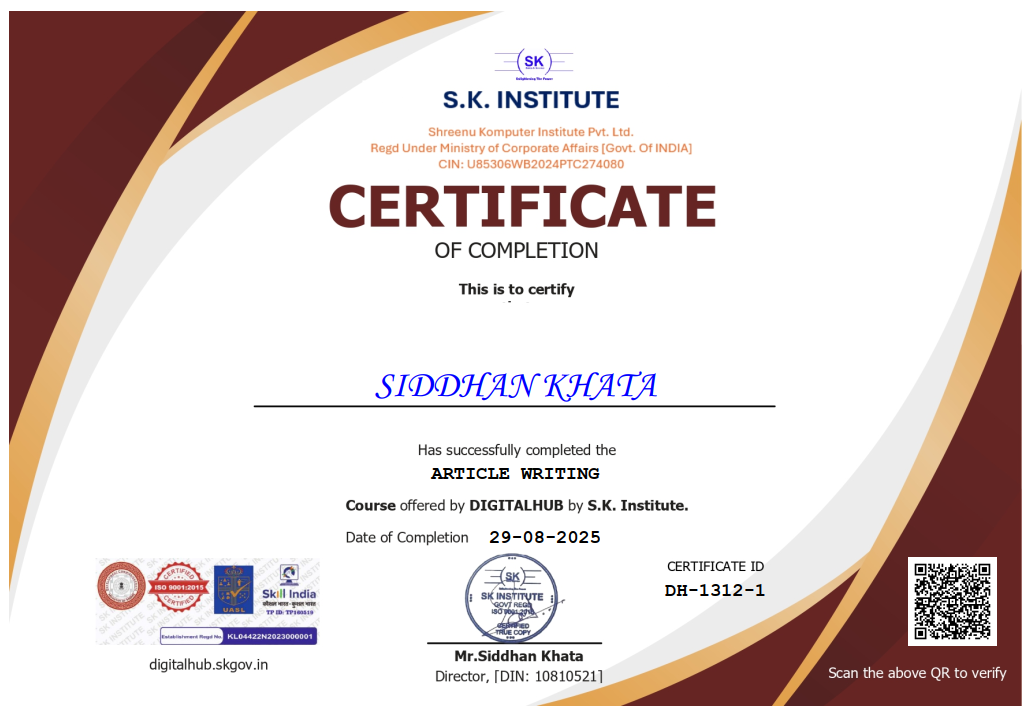
Test your knowledge and earn your certificate by taking the final assessment
MCQ Based
Score 50% or higher to receive Paid certification
You will get the certificate after completion of assessment by paying the respective fees.
Yes, our certificate is valid globally and got approved in top MNCs like Flipkart, Amazon, PayPal, SAP and even in Google.
Adding more than 5 certificates in your CV will be beneficial to you.
We are a Government of India registered institute, so don't worry about it.
Instantly after completing the assessment.
No, we trust you. First pass the exam, then click on the "Get Certificate" button, then pay the desired fees and unlock the certificate.
No worries! Just drop an email to digitalhub@skgov.in or call +919051767274 or WhatsApp +91 9051767274 within office hours (Monday - Saturday, 10 AM to 7 PM).
We have a global verification system. Just put your certificate number or email address and your verification page will appear with a link.
You will get it via email. If any issue arises, feel free to contact us.

